For thirty years, in a small town in Iowa, if your car broke down, you called Henry. Flat tire before work. Dead battery in January. A repair you simply could not afford. Henry fixed it, and Henry would not take your money. "Pay me when you can — or help someone else," he would say, wiping his hands on a rag, as if that were the most normal sentence in the world.
So when Henry's hands finally gave out at eighty and he quietly closed his garage, he believed something that turned out to be completely wrong: he believed nobody had noticed.
!Elderly mechanic Henry with a white beard and glasses in a blue work shirt fixing a car in his small Iowa garage
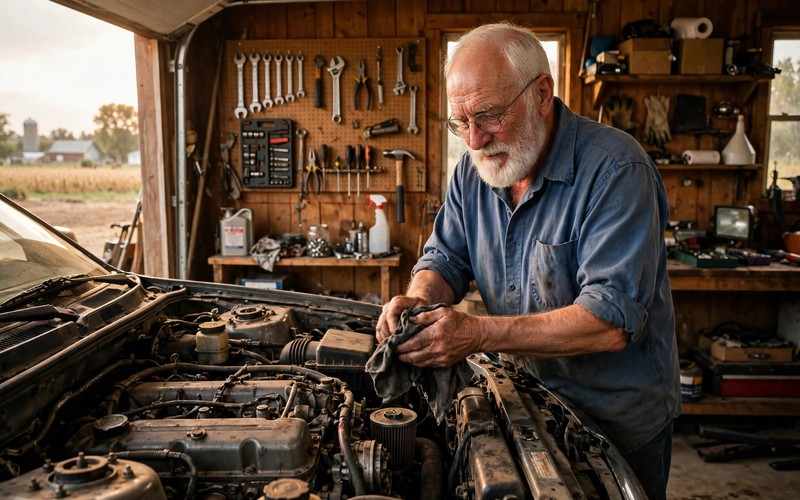
For thirty years, if your car broke down in his Iowa town, you called Henry.
A Garage That Was Never Really a Business
Henry's garage was not a business so much as a promise with a roof on it. There was no sign out front, no price list, no appointment book. There was a coffee pot that was always on, a radio playing low, and a man who could hear what was wrong with an engine the way other people hear a song slightly out of tune.
He fixed every car properly — never a shortcut, never a "good enough" job for someone who couldn't pay full price. A brake job for a stranger got the same care as a brake job for the mayor, because in Henry's mind there was no difference between the two. A car that carried a family to work and school had to be safe, and safe did not come in discount and premium versions.
And when the job was done, he waved off the wallet. Some people paid months later, when they could. Some paid in pies still warm from the oven, in firewood stacked neatly by his back door, in favors done for other people — the currency he actually preferred. And some never paid at all, and Henry never once brought it up. He never kept a list. Thirty years of free repairs, and there is not a single list anywhere. He would have been embarrassed by one.
The Single Mom at Six in the Morning
Ask around town and everyone has a Henry story, but they all sound strangely alike, because the man never changed his script.
There was the single mom whose car died on the coldest morning of January, with a shift starting at six and a babysitter already waiting. She called Henry in tears, apologizing for the hour, apologizing for having no money until Friday. Henry was already pulling on his coat. He jump-started her car in the driveway while his breath fogged in the cold air, checked her battery twice, and told her to drive safe and not worry about it. When she tried to press folded bills into his hand, he closed her fingers back around them and said the line the whole town knew by heart: pay me when you can — or help someone else.
She made her shift. She kept her job. And years later, when she was the one with a little extra, she was the first person to bring groceries to a neighbor who had lost work — because that is how Henry's currency works. It does not come back to him. It moves forward, hand to hand, until a whole town is quietly taking care of itself.
!Mechanic helping a single mother with a dead car battery early in the morning and refusing payment
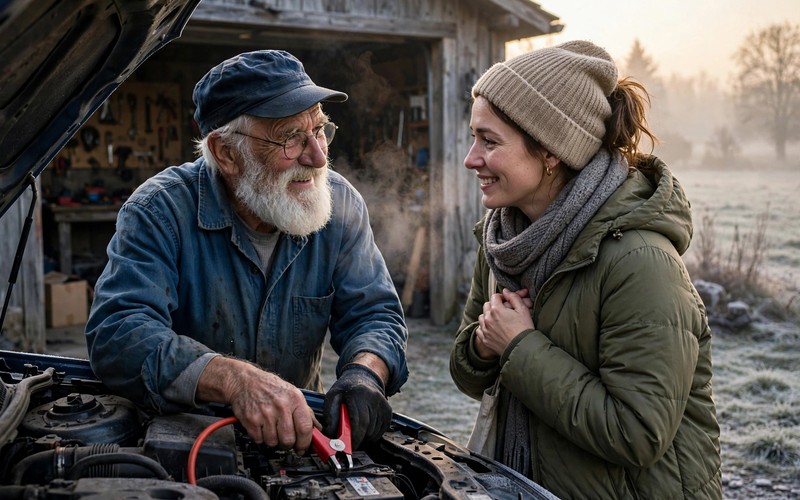
She tried to pay him. He closed her fingers back around the bills.
The Hands That Gave Out
At eighty, Henry's hands simply could not do it anymore. A wrench had become a heavy thing. The bolts he used to loosen without thinking now fought him, and his fingers, which had known every engine in town by feel, trembled when he tried to hold them steady.
He did not complain. That was never his way. One Friday, he swept the floor the way he always did at the end of the day, hung up his tools one by one, and pulled the big garage door closed for the last time. No announcement. No fuss. No goodbye party, because he did not think he deserved one. He told almost nobody.
That night, he sat in his kitchen with his coffee going cold and thought about thirty years of mornings in that garage — the engines, the neighbors, the kids who grew up and brought their own kids' cars to him. He assumed that was the end of it. A good run, a quiet ending. He was about to learn what thirty years of "help someone else" actually builds, because kindness, unlike a car, does not stay where you leave it. It travels. It multiplies. And sometimes, on an ordinary Saturday morning, it comes home all at once.
!Elderly mechanic slowly hanging his tools on the garage wall at dusk for the last time

One Friday, he swept the floor, hung up his tools, and closed the door for the last time.
Two Hundred Cars
The next Saturday morning, Henry heard engines.
Not one engine. Not a neighbor passing by. A low, rolling rumble that grew and grew until it filled the whole street, like a river coming around a bend. He opened his front door — and stopped.
Over two hundred cars lined his street, bumper to bumper, as far as he could see. Former neighbors. Grown-up kids whose first cars he had saved before graduation. Families from three towns over, people whose names he barely remembered and whose cars he remembered perfectly. They stood in his yard and along the sidewalk, holding coffee cups and casserole dishes, smiling at him like he was the guest of honor at a party he never knew was being planned.
They had organized it quietly, the way he always did things — no speeches announced in advance, no fuss, just people showing up. And they had raised money: enough to pay Henry's rent for a full year, and to fix up his own old truck, the one vehicle its mechanic never had time to repair because he was always too busy repairing everyone else's.
Henry stood in his doorway and cried. Not the quiet kind of crying, either — the shoulders-shaking kind, the kind that comes when a man who spent his whole life giving finally understands that he was never giving into the void. Every car on that street was a receipt. Every face was a thank-you he had refused to collect for thirty years, arriving all at once.
"I thought I was just fixing cars," he said.
He wasn't. He was building a town that shows up.
!Two hundred cars lined up along a small town street outside an elderly mechanic's garage to thank him

Two hundred cars, bumper to bumper, as far as he could see.
What Henry Actually Built
Here is the part of the story that matters most, and it has nothing to do with cars.
Henry never set out to be a hero. He never gave a speech about kindness or posted about his good deeds. He just fixed what was broken in front of him, charged nothing, and asked for one thing in return: pass it on. And because he asked for so little, people gave him everything — not in money, but in the only currency that ever mattered to him. They became the kind of neighbors who show up.
Every town has a Henry — the person who helps everyone and asks for nothing, who waves off the wallet and means it, who thinks nobody noticed. If you are lucky enough to know yours, do not wait for the street to fill with cars to tell them. Tell them now, while their hands can still hold a wrench, while they can still hear you say it.
And if you are Henry — if you are the one quietly fixing things for free, wondering whether any of it matters — look at that street. Two hundred cars long. That is what thirty years of showing up looks like when it finally comes home.
Share this with your town's Henry. And if you can, tell them before the whole street has to.