My dad's garage in Michigan smelled like oil, coffee, and old wood. It had tools older than me, a radio that only played classic rock, and one rule painted on the wall. I read it a thousand times without really hearing it. It took becoming a father myself — and losing him — to understand the rule was never about tools. It was about the kind of man he wanted me to be.
!Elderly father in a plaid shirt working in an old Michigan garage full of 1970s tools
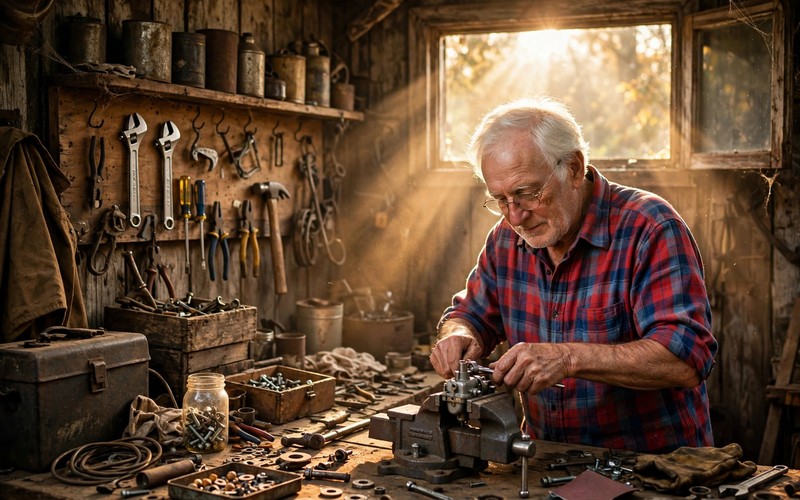
Dad's garage: oil, coffee, old wood, and a radio that only played classic rock.
The Rule on the Wall
The sign was simple, in Dad's own handwriting: "If you borrow it, bring it back cleaner."
It applied to everything: wrenches, ladders, the good drill he trusted almost nobody with. Borrowed things came back wiped down — or you heard about it, calmly, once, in a tone you never forgot.
At first I thought Dad was just particular about his tools. He was, but that was never the whole story. The rule was doing quiet work on everyone who read it. It said: whatever you touch in this life — a tool, a favor, a friendship, a place you were welcomed into — you leave it in better shape than you found it. You do not take without giving back. You do not walk away from a mess you made and expect someone else to clean it up.
Every kid on our street knew that sign. Neighbors borrowed the ladder and brought it back washed. A friend borrowed the drill and returned it oiled. Nobody had to be told twice, because Dad never raised his voice about it. He just lived it, every single day, and the garage itself taught the lesson.
!Hand-painted sign with a father's garage rule hanging on an old garage wall
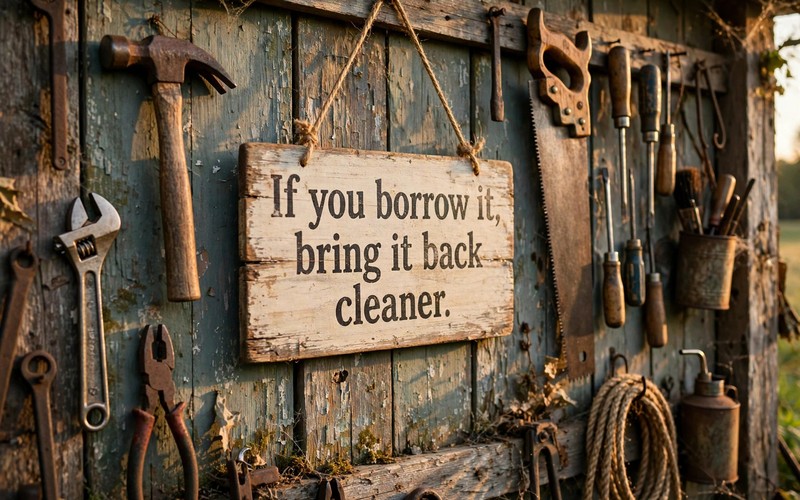
The rule, in Dad's own handwriting.
The Day I Learned It the Hard Way
I was fourteen when I broke the rule, and I still remember the silence that followed.
I had borrowed Dad's good drill to fix a shelf in my room. I was in a hurry, the way fourteen-year-olds always are, and I put it back dirty, the cord tangled, the case left open on the bench. Dad found it that evening. He did not yell. He did not take the drill away. He just picked it up, wiped it down slowly in front of me, coiled the cord the right way, and closed the case with a soft click.
Then he looked at me and said, "Son, the way you return a thing tells me how you respect the person who lent it to you."
That was it. No lecture, no punishment. But I have never forgotten that evening, because for the first time I understood the sign was not about a drill at all. It was about respect — the kind you show when nobody is watching, and the kind that follows you into every room you will ever walk into.
Lessons Disguised as Car Repairs
Dad taught me to change oil at twelve and fix a bike at fourteen. He would not do it for me, and he would not let me quit halfway. "Never pay a man for a job you can learn yourself," he used to say, handing me the manual instead of the answer.
I believed he was teaching me about cars. He wasn't. He was teaching me patience when a bolt won't move, and how to keep going when your hands are greasy and the light is bad and the job is only half done. He was teaching me to finish what I start, even when quitting would be easier and nobody would notice. He was teaching me respect for work done with your hands — the kind nobody claps for, and everybody depends on.
Those lessons followed me into every job I have ever had and every hard season since. When a project at work fell apart, I thought of Dad under that car, calm, methodical, refusing to force a bolt that needed patience instead of strength. When money was tight, I thought of his voice: learn it yourself first. When I became a father, I realized the garage had been his classroom all along, and I had been his student without ever knowing there was a lesson plan.
!Father teaching his young son to change oil in a family garage in the 1980s
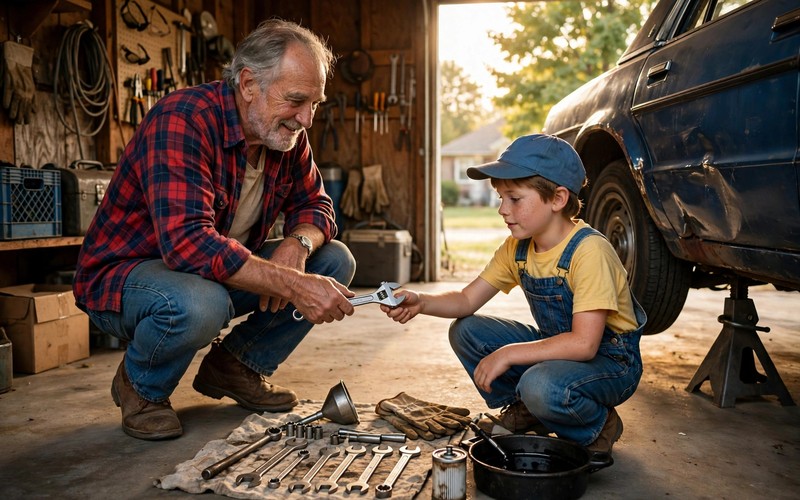
He never did a job for me that I could learn to do myself.
The Garage After He Was Gone
Dad is gone now. The day we cleared his garage, my siblings took tools and keepsakes — a level, a toolbox, the old radio that still played classic rock if you hit it just right. I took the sign.
Standing in that empty garage was the hardest part. Without his coffee mug on the bench and his plaid shirt on the hook by the door, the place felt smaller, like a room holding its breath. I ran my hand along the workbench where he had taught me everything that mattered, and I read the sign one last time on the wall where it had hung for thirty years.
I understood it then, fully, for the first time. Dad had never been protecting his tools. He had been protecting a way of living: borrow little, return more, leave every place and every person better than you found them. The sign was his whole philosophy, painted on a board, hung where his son would see it every day.
The Sign in My Garage Now
It hangs in my garage today, paint faded, where I see it every morning.
And this year, my own son started borrowing my tools — at that age where everything is fast and nothing gets put back. One evening I found a wrench left dirty on the bench, and I heard Dad's voice in my own mouth before I even thought about it.
So I taught him rule number one, calmly, once. "If you borrow it, bring it back cleaner." Then I watched him wipe down the wrench before he hung it up, the same way I once watched Dad wipe down that drill.
Dad would have pretended not to notice. Then he would have smiled the whole way back into the house.
!A father teaching his son to wipe down a wrench in a home garage, with a faded sign on the wall
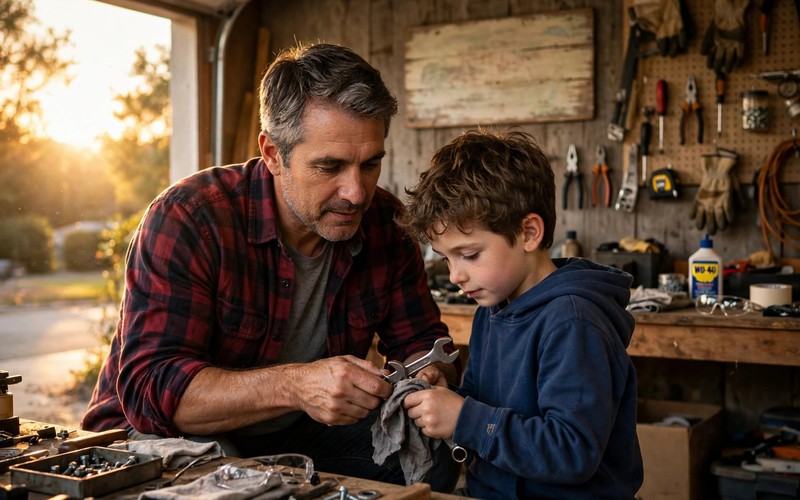
Rule number one, passed on to the next generation.
Why This Rule Still Matters
Every family has a place where its real values were taught — a kitchen table, a porch, a garage that smelled like oil and coffee. The lessons that last are rarely the ones delivered as lectures. They are the ones lived quietly, day after day, until they become part of who you are.
Dad's rule fits on a single board, and it still runs my life: return things cleaner. Return favors with interest. Leave people better than you found them. It is a small rule, and it is enough to build a good life on.
If this story moved you, share it with someone who learned life standing next to their dad, holding a flashlight. Chances are, they have a garage story of their own — and a rule on the wall they only understood years later.